How Real Estate Agents Use Digital Business Cards for Open Homes, Listing Appointments, and Faster Lead Follow-Up
Quick Answer
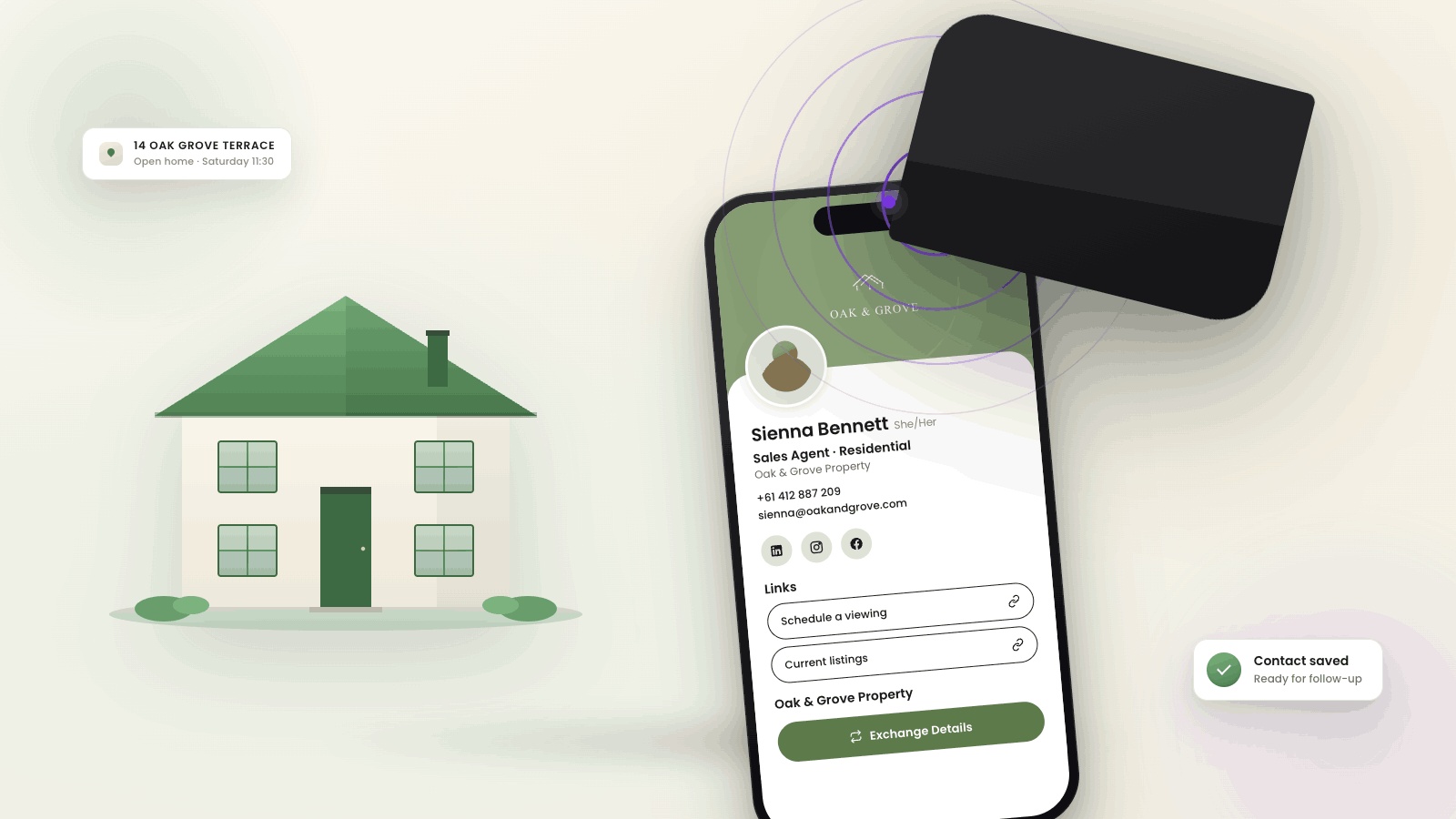
Real estate agents use digital business cards to turn in-person conversations into follow-up-ready contacts. At open homes, listing appointments, buyer inspections, auctions, and local networking events, an agent can share their profile by NFC tap or QR code, help the contact save their details instantly, and invite the buyer, seller, landlord, or referral partner to send their own details back.
For agencies, the value is not just replacing a paper card. The real gain is a cleaner handoff from conversation to follow-up: fewer lost details, faster callbacks, better branded profiles, and less manual data entry after a busy inspection day.
Key Takeaways
- Digital business cards help agents share details instantly and capture buyer or vendor interest while the conversation is still fresh.
- Open homes are a natural use case because buyers already expect mobile-first property experiences, inspection planning, and quick agent contact.
- Listing appointments feel more polished when an agent can share a branded, updateable profile with direct contact options and useful vendor links.
- Faster lead follow-up matters: lead-response research has found that calling within five minutes can dramatically improve the odds of contacting and qualifying a lead compared with waiting 30 minutes.
- Real estate agencies should look for NFC and QR sharing, no-app access, two-way contact exchange, team controls, analytics, and CRM-friendly workflows.
Why Do Digital Business Cards Fit Real Estate So Well?
Real estate is still a relationship business, but the buyer and vendor journey is now heavily digital. In the National Association of Realtors' 2025 generational trends report, 46% of buyers said their first step was looking online for properties, while 20% contacted a real estate agent first (NAR 2025 Home Buyers and Sellers Generational Trends). That mix matters: buyers research digitally, then rely on agents when decisions become specific.
A paper card often fails at exactly that handoff. It can be left behind, photographed and forgotten, or saved incorrectly. A digital business card for real estate agents keeps the contact step on the same device the buyer or vendor is already using to search, plan inspections, compare properties, and message agents.
The practical benefit is simple. The agent can say, "Tap here and you'll have my details," then the contact can open the profile, save the agent, call, email, view relevant links, or share their own details back.
How Can Agents Use Digital Business Cards at Open Homes?
Open homes are the highest-volume use case. Agents are greeting visitors, answering questions, managing traffic through the property, reading buyer intent, and trying to remember who needs a contract, price guide, rental estimate, or callback.
With an NFC business card, the agent can give visitors a simple action before they leave:
- Tap or scan the card.
- Open the agent's digital profile.
- Save the agent's details.
- Share contact details back if they want the price guide, contract, similar listings, or appraisal follow-up.
That workflow fits existing inspection behaviour. On realestate.com.au, some inspection registrations require property seekers to provide their details to the agent before the inspection is added to their plan (REA Support, Managing property inspections). A digital card can support the same idea in person: make it easy for interested people to identify themselves, then make follow-up easier for the agent.
This is especially useful when the open home is busy. Instead of relying on memory or handwritten notes, the agent can capture cleaner context while the buyer is still standing in the property.
What Should Happen After a Buyer Taps or Scans?
The tap should lead to a useful next step, not just a static contact page. The best open-home flow is short:
- The buyer taps the card or scans the QR code.
- The profile opens in the browser, with no app required.
- The buyer saves the agent's details.
- The buyer submits their own details if they want follow-up.
- The agent uses that information to send the right next message.
Tapt supports this kind of two-way contact workflow through contact exchange. Admins can configure the contact exchange form fields in Tapt, so teams can collect relevant details instead of just handing out a profile (Tapt Help Center, editing and enabling contact exchange).
For a real estate agent, useful fields might include enquiry type, buying or selling timeframe, preferred suburb, budget range, property address for appraisal, or whether the visitor wants similar listings. Keep the form short. The goal is not to interrogate the person at the door. It is to capture enough context to follow up properly.
How Do Digital Cards Help at Listing Appointments?
Listing appointments are less about volume and more about confidence. A vendor wants to know whether the agent is organised, responsive, credible, and able to present the property well.
A digital card can work as a polished leave-behind. Instead of handing over a paper card that only contains a name and phone number, the agent can share a branded profile with:
- Direct mobile and email details.
- Agency website and office links.
- Recent sales or suburb report links.
- Appraisal booking links.
- Social proof or review profiles.
- A vendor guide or campaign information.
The updateability matters. If the agent changes office, updates their mobile, adds a new appraisal form, or wants to promote a suburb report, the profile can be edited without reprinting cards. For agency teams, centralised digital business card management also helps keep branding consistent across agents, offices, and campaigns.
How Can Agents Use Digital Cards for Private Inspections and Auctions?
Private inspections are more focused than a busy open home. The buyer may have specific questions about contract conditions, settlement timing, comparable sales, or upcoming stock. A digital card gives the agent a quick way to keep that conversation moving after the appointment.
Auctions and appraisal days are similar. The interaction may be brief, but the contact can be valuable. A potential vendor might ask what their property is worth. An investor might want rental information. A neighbour might be considering a sale in the next six months. A referral partner might want to stay in touch.
The digital card should support the conversation naturally:
- "Tap here and you'll have my direct details."
- "Send your details through there and I'll send the contract."
- "If you want similar listings, share your preferred suburbs and budget."
- "For an appraisal, add the property address and I'll come back to you."
The card does not replace the agent's judgement. It simply makes the next step easier to capture.
Why Does Faster Lead Follow-Up Matter?
Real estate interest cools quickly. A buyer who loved a property at 11am may be comparing three others by the afternoon. A vendor who asked for an appraisal may speak with another agency before the end of the day.
That is why speed-to-lead matters. The MIT Lead Response Management study reports that calling within five minutes increased the odds of contacting and qualifying a web-generated lead by 100 times and 21 times respectively compared with waiting 30 minutes (MIT Lead Response Management Study). A real estate open home is not the same as a web form, but the operational lesson is relevant: the faster the team can move from enquiry to response, the less opportunity leaks out of the process.
Digital business cards help because they reduce the delay between meeting and action. Instead of deciphering handwriting, searching for a buyer's number, or waiting until the end of the day to enter notes, the agent can receive cleaner details at the point of conversation.
If the agency uses automation, captured contacts can also move into follow-up workflows. Tapt supports Zapier integration setup for passing Tapt events into other tools, which can help teams connect contact exchange to the systems they already use (Tapt Help Center, Zapier integration setup).
What Should Real Estate Agencies Look For?
Not every digital card setup is strong enough for real estate. Agencies should evaluate both the agent experience and the admin workflow.
Important features include:
- NFC tap and QR code sharing, so agents have a backup when one sharing method is not convenient.
- No-app access for recipients, so buyers and vendors can open the profile quickly.
- Two-way contact exchange, so the contact can send details back to the agent.
- Editable profiles, so phone numbers, office details, links, and campaign resources stay current.
- Brand controls, so every profile feels like part of the same agency.
- Team management, so admins can issue, update, reassign, or deactivate cards.
- Analytics, so the agency can see usage and adoption across the team.
- CRM or automation options, so captured contacts can support follow-up rather than sitting in a disconnected inbox.
- Privacy-conscious forms, so people understand what they are sharing and why.
For real estate, the best card is not the one with the most visual effects. It is the one agents will actually use at the front door, in the lounge room, at the auction, and between appointments.
Where Does Tapt Fit?
Tapt provides digital and NFC business card experiences for individuals and teams. For real estate agents, Tapt is relevant because it supports the core workflow: share an up-to-date profile, help the contact save details, collect lead information through contact exchange, and give agencies a more consistent way to manage branded cards.
For a solo agent, that can mean one reusable card linked to a profile that is always current. For an agency, it can mean a team rollout where every agent has a consistent branded profile, while admins retain more control over details, links, and card management.
The strongest fit is a real estate team that wants digital cards to support actual follow-up, not just look modern. Used well, a Tapt profile can sit alongside open-home systems, listing presentations, appraisal campaigns, and CRM workflows as a small but practical part of the agency's lead-capture process.
Practical Scripts Agents Can Use
The invitation should be simple. The agent does not need to explain the technology.
At an open home:
"If you'd like the price guide or updates on similar homes, tap here and send me your details."
At a listing appointment:
"I'll leave you with my digital card. It has my direct number and the links we discussed."
At a private inspection:
"Tap here and you'll have my details saved. If you want the contract, send your details through there as well."
At an appraisal conversation:
"Share the property address through my card and I'll come back to you with the next steps."
At a networking event:
"I'll share my digital card with you. You can save my details and send yours back so I can follow up properly."
Conclusion
Real estate is built on timely conversations. Digital business cards help agents make those conversations easier to continue after the open home, listing appointment, inspection, auction, or networking event ends.
For individual agents, the benefit is convenience and faster follow-up. For agencies, the bigger opportunity is consistency: branded profiles, team management, cleaner contact capture, and fewer missed next steps. When used well, a digital business card becomes more than a modern replacement for paper. It becomes a practical part of the agency's lead follow-up engine.